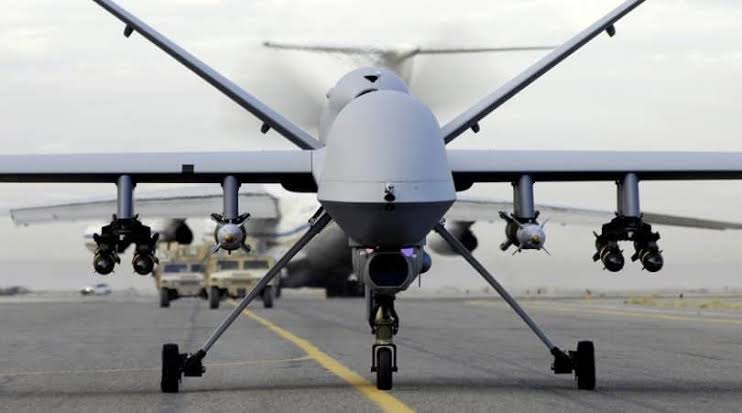
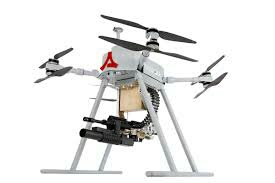
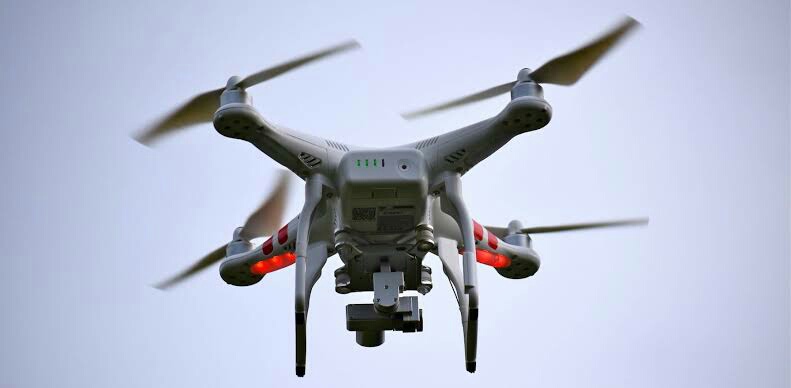
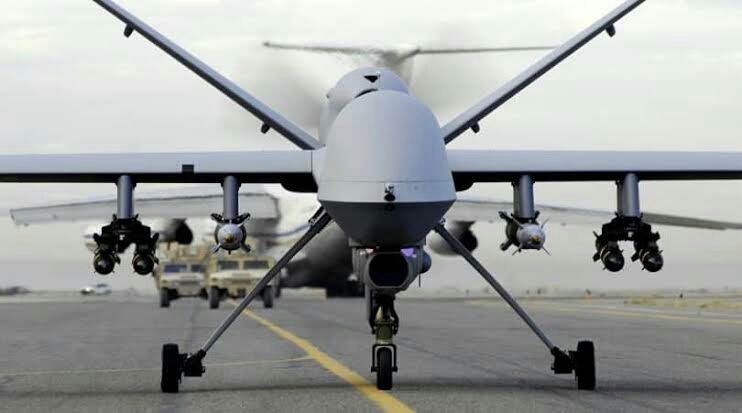
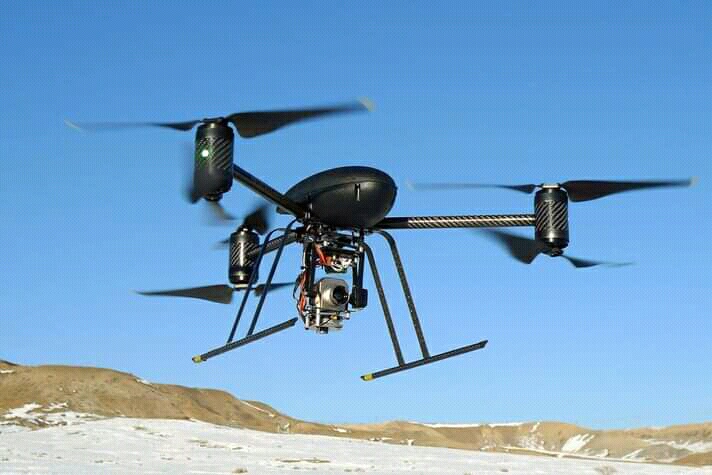
In the official vocabulary of the U.S. Army, a drone is defined as “a land, sea, or air vehicle that is remotely or automatically controlled.” The drone family is not composed solely of flying objects. There may be as many different kinds as there are families of weapons: terrestrial drones, marine drones, submarine drones, even subterranean drones imagined in the form of fat mechanical moles. Provided there is
no longer any human crew aboard, any kind of vehicle or piloted engine can be “dronized.” A drone can be controlled either from a distance by human operators (remote control) or autonomously by robotic means (automatic piloting). In practice, present-day drones combine those two modes of control. Armies do not yet have at their disposal operational autonomous lethal robots, although as we shall see, there are already advanced plans for those.The term “drone” is mainly used in common parlance. Military jargon refers to “unmanned aerial vehicles” (UAVs) or to “unmanned combat air vehicles” (UAVs), depending on whether the contraption carries weapons. This work will focus on the case of armed flying drones, the ones that are known as “hunter-killers” and used in the attacks regularly reported by the press. Their history is that of an eye turned into a weapon. “We’ve moved from using UAVs primarily in intelligence, surveillance, and reconnaissance roles before Operation Iraqi Freedom,” said a U.S. Air Force general, “to a true hunter-killer role with the Reaper”—a name that “captures the lethal nature of this new weapon system.”
The best definition of drones for military is probably the following: “flying, high-resolution video cameras armed with missiles.”
-David Deptula, an Air Force officer, identified their basic strategy: “The real advantage of unmanned aerial systems is that they allow you to project power without projecting vulnerability.”5
“Projecting power” should here be under-
stood in the sense of deploying military force regardless of frontiers: a matter of making military interventions abroad,
the problem of extending imperial power from the centre over the world that constitutes its periphery. In the history of
military empires, for many years “projecting power” meant “sending in troops.” But it is precisely that equation that
now has to be dismantled. Self-preservation by means of drones involves putting vulnerable bodies out of reach. This could be seen as the fulfillment of the ancient desire that inspires the whole history
of ballistic weapons: to increase one’s reach so as to hit the enemy from a distance before the opponent can launch its
own attack. But with drones, the weapon’s range (the distance between the weapon and its target) has been increased
by the range of the remote control (the distance separating the operator from the weapon). Thousands of miles can now
be interposed between the trigger on which one’s finger rests and the cannon from which the cannonball will fly.
However, “projection of power” is also a euphemism that obscures the facts of wounding, killing, destroying. And to
do this “without projecting vulnerability” implies that the only vulnerability will be that of the enemy, reduced to the status of a mere target. Underlying the palliative military rhetoric, as Elaine Scarry detects, the real claim is that the “successful strategy is one in which the injuring occurs only in one direction. . . . Thus, the original definition, which seems to posit non-injuring against injuring, instead posits
one-directional injuring against two-directional injuring.”
By prolonging and radicalising preexisting tendencies, the armed drone goes to the very limit: for whoever uses such a weapon, it becomes a priori impossible to die as one kills. Warfare, from being possibly asymmetrical, becomes absolutely unilateral. What could still claim to be combat is converted into a campaign of what is, quite simply, slaughter. The use of this new weapon is most marked by the United States. That is why I have borrowed from that country most of the facts and examples upon which my thesis is based. At
the time of writing, the American armed forces had at their disposal more than six thousand drones of various kinds; more than 160 of these were Predator drones in the hands of the U.S. Air Force.
For both the military and the Central Intelling end Agency (CIA), the use of hunter-killer drones has become commonplace, to the point of being routine. These machines are deployed not only in zones of armed conflict, such as Afghanistan, but also in countries officially at peace, such as Somalia, Yemen, and above all Pakistan, where CIA drones carry out on average one strike every four days. Exact figures are very hard to establish, but in Pakistan alone estimates of the number of deaths between 2004 and 2012 vary from 2,640 to 3,474.10 The use of this weapon has grown exponentially: the number of patrols by American armed drones increased by
1,200 percent between 2004 and 2012.11 In the United States today, more drone operators are trained than all the pilots
of fighter planes and bombers put together.12 Whereas the defence budget decreased in 2013, with cuts in numerous sectors, the resources allocated to unmanned weapon systems rose by 30 percent.13 That rapid increase reflects a strategic plan: the gradual dronization of an increasing portion of the American armed forces.14
The drone has become one of the emblems of Barack Obama’s presidency, the instrument of his official antiterrorist doctrine, “kill rather than capture”15: replace torture and Guantanamo with targeted assassination and the Predator drone.
Follow http://www.alexandriafranklins360technology.tech.blog for more updates.


 Alexandria Franklin's 360° Technology news blog 🌏